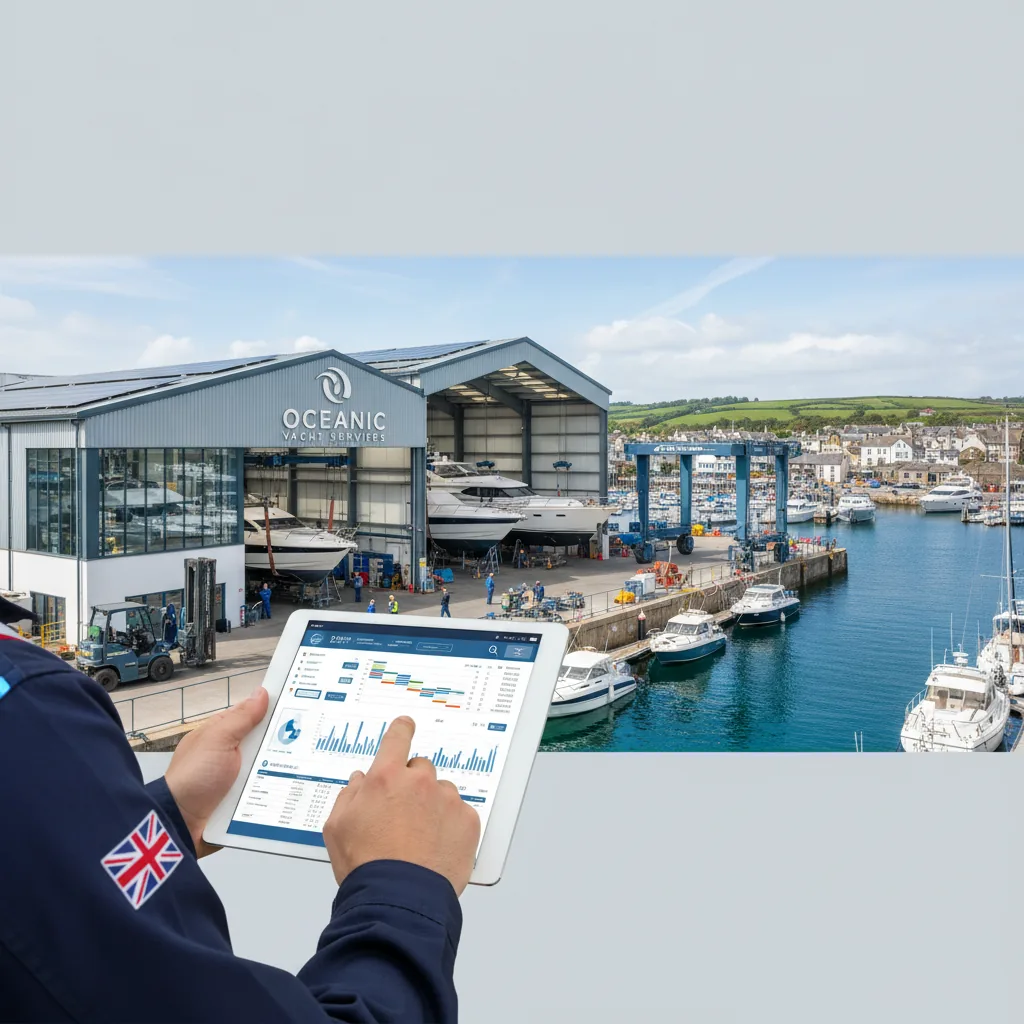
Marine Workshop Management Software: A UK Operator’s Guide
Simplify your boat yard operations, improve technician productivity, and boost profitability with purpose-built marine workshop management software.
9 min read By PayCamp Yards TeamManaging a busy UK boat yard or marina workshop is a complex balancing act. From seasonal surges in winterisation and de-winterisation to emergency engine repairs and routine hull maintenance, the sheer volume of administrative tasks can often overshadow the skilled technical work your team provides. In an era where customer expectations are higher than ever, relying on spreadsheets, paper diaries, or generic accounting software is no longer sustainable.
Specialised marine workshop management software is no longer an optional luxury; it is the backbone of a modern, profitable marine business. For UK operators, the challenge lies in finding a solution that understands the unique nuances of our industry—from managing RCD compliance and VAT on marine parts to coordinating with yard teams during the frantic spring launch window. This guide explores how the right digital tools can transform your workshop from a chaotic cost-centre into a simpler, high-margin operation.
In many UK boat yards, the 'system' still involves a whiteboard in the foreman's office and a stack of dog-eared paper job cards. While this might feel familiar, it creates significant invisible costs. Information silos mean that the front office rarely knows exactly how many hours have been logged against a specific hull until the end of the week, leading to delayed invoicing and poor cash flow.
Furthermore, paper-based systems are prone to human error. Parts used on a job are frequently forgotten, and technician notes are often illegible or incomplete. This results in 'leakage'—where billable time and materials are never charged to the client. By transitioning to marine workshop management software, you centralise every data point, ensuring that every screw, litre of antifoul, and billable hour is tracked in real-time. This level of oversight is essential for maintaining healthy margins in a competitive market.
Capture Every Consumable
A boat yard does not exist in a vacuum. The efficiency of your workshop is inextricably linked to the movement of vessels within your marina or dry-stack. One of the primary advantages of modern software is the ability to bridge the gap between back-office administration and yard operations. Linking your workshop tasks to your berth occupancy ensures that your team isn't searching for a vessel that hasn't arrived yet, or blocking a slip with a boat that requires another three days of engine work.
For a holistic approach, many operators find success by optimising operations with berth management software. When your workshop management tool communicates with your berthing system, you can automate notifications. For example, when a repair is marked as 'Complete' in the workshop module, the berthing team can be automatically alerted to move the vessel back to its pontoon, freeing up valuable workshop space immediately.
The Power of Photos
The heart of your workshop is your team of marine engineers, shipwrights, and electricians. Asking these highly skilled professionals to spend 20% of their day on paperwork is a poor use of resources. Marine workshop management software solves this by putting the system directly into their hands via mobile devices.
Implementing mobile job cards for marinas allows technicians to clock onto jobs, record part usage, and snap 'before and after' photos of their work. This not only improves data accuracy but also provides a professional audit trail for the customer. In the event of a dispute over a bill, having timestamped photos and detailed technician notes available at the click of a button is invaluable for a UK boat yard manager.
Scheduling in a marine environment is notoriously difficult due to weather dependencies and the unpredictable nature of marine repairs. Traditional scheduling often leads to 'dead time' or, conversely, overbooked weeks where staff are burnt out. Effective marine workshop management software provides a visual, drag-and-drop interface for resource planning.
By mastering technician scheduling for boat yards, managers can see at a glance who is over-allocated and who has capacity. You can group jobs by skill set—ensuring your lead electrician is on complex rewiring tasks while apprentices handle more routine maintenance. This strategic oversight allows for better long-term planning, particularly during the busy 'lift-out' season in autumn, ensuring you maximise every available labour hour.
Managing a marine parts inventory is a logistical headache. From specialist engine components to consumable resins and fixings, keeping the right stock levels is critical. Marine workshop management software automates this by linking parts usage directly to work orders. When a technician uses a part, it is automatically deducted from stock and added to the customer’s invoice.
Beyond inventory, the financial reporting capabilities of these systems provide UK operators with a 'single source of truth'. You can run reports on technician recovery rates, profit margins per job type, and even track the performance of specific departments. This data-driven approach allows you to identify which services are your real money-makers and which may need a price adjustment to remain viable.
Founder & Lead Developer
Fourteen years living aboard, thirty years in IT, and five years supporting dealer management systems in the motor trade — back to configuring FoxPro-based dealer systems in 1998. Hamish has spent a long time on the customer side of a yard office, which is why PayCamp Yards is built for both sides of the counter.
Learn more about our team →PayCamp Yards: purpose-built software for UK boat yards.